
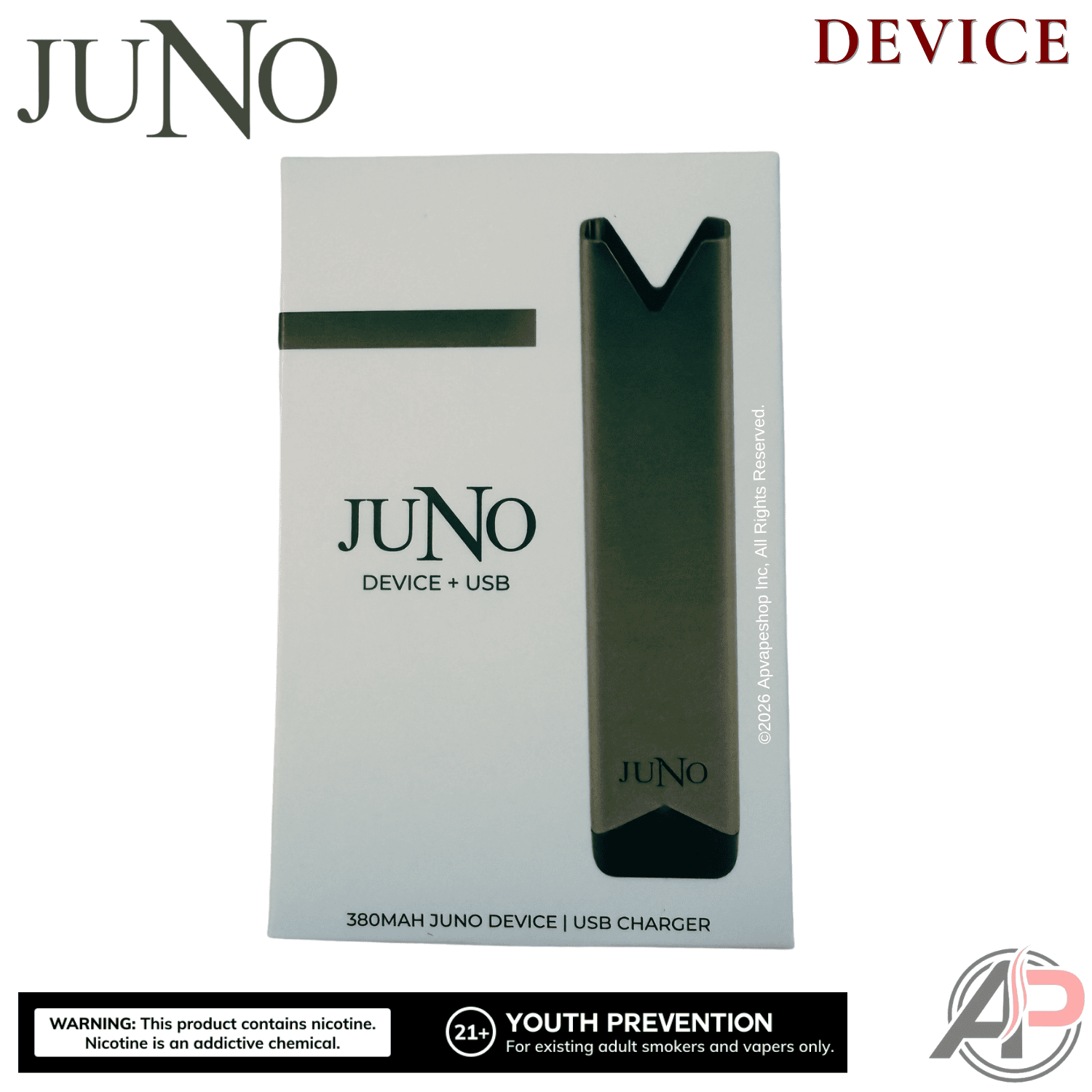
The battery is easy to overlook when people talk about pod systems – everyone wants to talk flavor and nicotine strength – but the Juno Vape Battery Device is really what makes the whole system work day to day. It’s the rechargeable base every Juno pod clicks into, and here’s what it actually does and how it pairs with the pods.
What the Battery Actually Does, and How It Connects to the Pod
Juno kept things simple here – no buttons, no wattage settings, nothing to configure. The device is draw-activated, firing automatically the moment you inhale, the same way a JUUL or similar closed pod system works. Inside is a 380mAh battery that charges through Micro USB, rated to typically last a full day or more depending on how often you’re vaping. A tri-color LED near the base gives a quick read on battery life: green for plenty of charge, yellow as things run low, red when it’s time to plug in – a small detail that saves you from the awkward moment of a pod suddenly stopping mid-draw.
The connection itself uses dual pins plated in 24K gold, which sounds like a minor spec sheet detail but actually matters for long-term reliability, since gold-plated contacts resist corrosion better than plain metal ones, keeping the connection consistent even after repeated pod swaps. There’s also a V-shaped cutout on top that lets you glance at how much e-liquid remains in whichever pod is currently inserted, without popping it out to check. This battery is built specifically for Juno pods and won’t work with other brands’ cartridges – if you’re running Juno Menthol Pods or Juno Tobacco Pods, this is the only battery that pairs with them, and the box ships with the device, a Micro USB cable, and a basic manual, with no pod included.
Why the Battery Matters More Than People Expect
A lot of pod system complaints that seem like a coil or flavor issue actually trace back to the battery, not the pod. Juno tuned this device specifically for pods using a 1.3-1.5Ω atomizer resistance, so pairing it with anything outside that range isn’t really an option, but it also means performance stays consistent as long as the battery itself is healthy. Built-in protections against short circuits and low voltage help prevent the battery from degrading a pod’s performance over time, which is part of why replacing an aging battery can sometimes fix issues people assume are a bad batch of pods. If your device has started firing inconsistently, draws feel weaker than they used to, or the LED behaves oddly even after a full charge, that’s usually a sign the battery itself has reached the end of its life rather than anything wrong with the pod.
Draw-activated, button-free batteries aren’t unique to Juno – brands like JUUL and Vuse use a similar approach – but there are small differences worth knowing if you’ve used other systems before. Juno’s tri-color LED is a bit more informative than some competitors that only use a single-color light or no indicator at all, giving a clearer sense of exactly where your charge level stands rather than a vague on-or-off signal. The gold-plated pin connection is worth mentioning again here too, since some competing pod batteries rely on simpler metal contacts that can wear down or lose consistency faster with repeated pod changes.
Getting the Most Out of It, and Knowing When to Replace It
A little care goes a long way with a small built-in battery like this one. Letting it run all the way down to nothing before recharging isn’t necessary and can shorten its overall lifespan faster than topping it up more regularly – it’s generally better to plug it in once the LED shifts to yellow rather than waiting for red, since lithium batteries in general tend to hold up longer when they’re not repeatedly drained to empty. Storing the device somewhere cool rather than somewhere hot, like a car dashboard in summer, also helps preserve battery health over time, since heat is one of the more common reasons small vape batteries degrade faster than expected.
Even with good charging habits, no built-in battery lasts forever. Most users find that somewhere between six months and a year of regular use, a battery starts showing its age: slightly shorter runtime between charges, occasional inconsistent firing, or an LED that doesn’t track reality the way it used to. None of that means something is broken, it’s just the natural wear pattern for a small rechargeable cell charged and discharged hundreds of times, and at that point replacing the battery rather than troubleshooting pods is usually the more effective fix, especially once you’ve already ruled out a bad pod by trying a fresh one. Keeping a spare battery on hand isn’t a bad idea if you vape often, since a dead or failing battery is a more disruptive problem than an empty pod – you can swap pods in seconds, but you can’t vape at all without a working battery. It’s also worth noting that Micro USB, rather than USB-C, is the charging standard here, so if most of your other devices have moved to USB-C, keep the included cable somewhere you won’t lose it.
Traveling with the device is worth a quick mention too, since built-in lithium batteries get treated differently than removable ones at airport security. Because the battery isn’t removable and the capacity is small, it generally travels fine in carry-on luggage without issue, though TSA rules around e-cigarettes change often enough that checking current guidance before a flight is a good habit regardless of which device you’re carrying. For everyday use, the bigger practical point is just making sure the Micro USB cable goes in your bag alongside the device – it’s a less common connector these days, and an easy thing to leave behind if you’re used to grabbing a USB-C cable by habit.
Worth Knowing Before You Buy
If you’re setting up a Juno system for the first time, or your current battery is starting to show its age, grab the Juno Vape Battery Device at Apvapeshop and pair it with whichever pod flavor you’re already vaping or ready to try.